Published on January 29, 2026
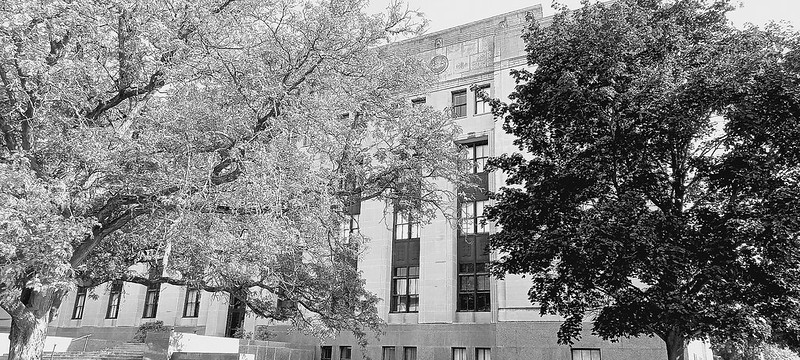
The former Kalamazoo County Building, an early seat of local governance and judicial authority, now stands as a reminder of the institutions that shape, and too often fail, the people they are meant to serve. Photo credit: Kzoo Cowboy (Flickr).
For the past year, my advocacy in Kalamazoo has extended far beyond housing. Through countless conversations with residents, former employees, whistleblowers, and people directly impacted by local systems, one truth has become impossible to ignore:
These are not isolated failures.
They are patterns.
Housing instability, court entanglement, nonprofit gatekeeping, and institutional indifference are not separate crises. They are interconnected systems operating under the same logic: rules over people, liability over dignity, compliance over compassion.
When one system fails, people do not simply “fall through the cracks.”
They are pushed.
And when multiple systems fail in alignment, the harm compounds.
Nonprofits are often viewed as the moral counterweight to government and courts — the place where humanity fills the gaps bureaucracy leaves behind. But when nonprofit organizations operate without meaningful oversight, transparency, or accountability, they can reproduce the same structural harm they claim to exist to remedy.
Rules become shields.
Policies become walls.
Funding becomes protection from scrutiny.
And the people meant to be served become risks to manage rather than lives to protect.
Across cities like Kalamazoo, the same stories repeat:
• Denial of services based on rigid policy.
• Retaliation against staff who advocate too strongly.
• Prioritization of institutional stability over human survival.
• Silencing of those who challenge internal misconduct.
• Communities told to be grateful for help that comes with conditions that degrade dignity.
This is not about one organization.
It is about a system that rewards appearance over accountability.
What makes nonprofit failure especially dangerous is the language of benevolence that surrounds it. Harm cloaked in charity is harder to confront. Power exercised under the banner of “help” resists challenge. And accountability becomes framed as attack rather than responsibility.
But systems meant to serve the vulnerable must be held to a higher standard — not a lower one.
Transparency is not optional.
Oversight is not hostility.
Accountability is not ingratitude.
It is the foundation of ethical service.
When courts, housing authorities, city leadership, and nonprofit organizations all operate without effective checks, the result is not isolated injustice — it is systemic abandonment.
People are left navigating overlapping systems that each claim limited responsibility, while collectively producing devastating outcomes.
And the most dangerous phrase in institutional culture becomes:
“That’s just policy.”
Policy without accountability becomes permission.
Permission to deny.
Permission to dismiss.
Permission to disappear people behind procedures.
Kalamazoo is not unique in this.
But it is a place where these patterns are visible — if we are willing to look.
This work is not about targeting individual organizations.
It is about exposing systems that have learned how to operate without consequence.
And insisting that those who claim to serve the public must answer to the public.
Because justice is not measured by mission statements.
It is measured by what happens to people when no one is watching.
Systems do not change when silence protects them.
They change when truth is documented, and responsibility is demanded.
—
Jennifer L. Dayton
Founder & Executive Director
Kalamazoo Justice Project, Inc.
The Kalamazoo Justice Project is a nonprofit organization dedicated to exposing housing injustice and supporting tenants through advocacy, transparency, and truth.
Legal & Editorial Disclaimer
This article is published for informational and educational purposes only and is based on publicly available information, reporting, and documented patterns as of the date of publication. It does not constitute legal advice, and nothing herein should be construed as an allegation of unlawful conduct unless expressly stated and supported by cited sources. All institutions and systems referenced are discussed in their public or operational capacities. The views expressed are those of the author and are intended to advance public understanding of civic, legal, and social accountability.
Context
This piece reflects patterns observed through court monitoring, housing advocacy, nonprofit governance research, and community reporting conducted by the Kalamazoo Justice Project. Future investigative pieces will include document-based sourcing and public-record citations.
 English